Infrared Sauna vs
Traditional Sauna.
Both promise heat, relaxation and a serious wellness ritual. But they create that heat differently — and the better choice depends on what you actually want from the experience.
Traditional sauna has centuries of history behind it. Infrared sauna is the newer wellness contender, promising a different way to experience heat at lower air temperatures. So which one is actually worth your time — and potentially your money?
The first thing to understand is that these are not simply two versions of exactly the same machine.
A traditional sauna heats the room around you. An infrared sauna uses infrared radiation to transfer heat more directly towards the body while generally operating at a lower ambient temperature.
Both can make you hot. Both can make you sweat. Both can become enjoyable rituals.
But that does not mean every claim surrounding them should be treated equally.
Traditional sauna is the stronger choice if you want the classic, hotter sauna experience and the deepest body of long-term sauna research. Infrared may suit people who prefer gentler ambient heat, easier home installation and a more tolerable longer session. Neither should be viewed as a miracle treatment.
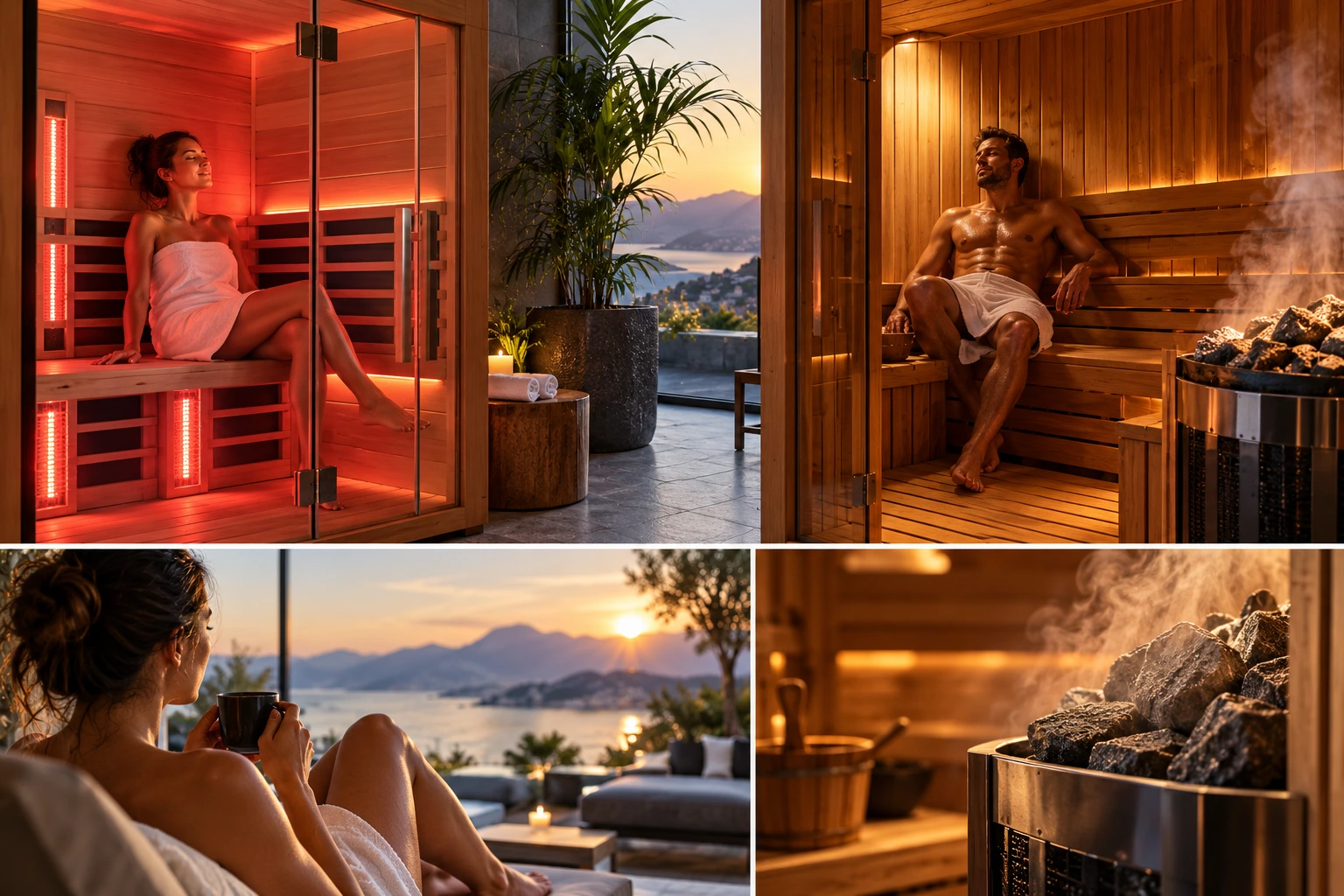
Different technologies. Similar ritual. The experience can feel considerably different.
One heats the room. The other delivers radiant heat.
Hot air, wood and stones.
A traditional sauna heats the surrounding air, which then heats your body.
Many traditional saunas also use heated stones. Water can be poured onto them to create bursts of steam and temporarily increase humidity.
The result is the unmistakable intense sauna environment associated with Finnish sauna culture.
Radiant heat at lower air temperatures.
Infrared cabins use infrared emitters rather than relying primarily on extremely hot surrounding air.
The cabin itself can therefore feel less aggressively hot while the user still experiences substantial warmth.
For some people, that makes the experience easier to tolerate for longer periods.
Infrared vs traditional sauna.
There is no universal winner because the technologies solve slightly different problems.
Someone who loves the intense heat and ritual of a traditional sauna may find infrared underwhelming. Someone who struggles with very hot rooms may find infrared considerably easier to use consistently.
Is infrared sauna better than traditional sauna?
Not inherently.
Infrared's main practical advantage is that it can provide a strong warming experience without requiring the surrounding air to become as hot as a traditional sauna.
That can make infrared attractive for home users and for people who dislike the intensity of very hot sauna rooms.
Traditional sauna, meanwhile, offers the classic heat experience and has a longer cultural history and a broader research literature around habitual sauna bathing.
The right question is therefore less about which technology wins and more about which one you will actually enjoy and use regularly.
Consistency may matter more than specification.
Wellness technology has a habit of becoming a competition between numbers: temperature, wavelengths, session length, power output and increasingly elaborate features.
But the most useful system may simply be the one that fits naturally enough into your life that you continue using it.
Separate sauna research from sauna marketing.
Sauna use is associated with interesting cardiovascular, relaxation and wellbeing research, particularly in populations where traditional sauna use is a long-established habit.
But there is an important distinction between evidence associated with regular sauna bathing and marketing claims made for an individual consumer product.
Claims around “detoxification”, dramatic fat loss, curing disease or other sweeping outcomes deserve particular scepticism.
Sweating is a normal temperature-regulation mechanism. It should not automatically be interpreted as evidence that a device is removing meaningful quantities of unspecified “toxins”.
Buy a sauna because you value the heat, relaxation, ritual and potential evidence-supported benefits — not because a manufacturer promises that sweating will solve every wellness problem.
Is a home infrared sauna worth it?
This is where infrared becomes commercially interesting.
A home system removes the journey to a spa or gym and turns sauna use into something that can potentially happen several times each week without much planning.
That convenience has genuine value.
But premium prices only make sense if the system will actually be used. A beautiful cabin that becomes expensive storage after three months is not a wellness investment.
Before buying, consider the physical footprint, electrical requirements, warm-up time, warranty, construction quality, emitter configuration and whether the cabin is genuinely comfortable enough for the number of people advertised.
Sauna, red light and cold plunge.
These technologies increasingly appear together in premium home wellness spaces.
That makes sense commercially — but they are not interchangeable.
Sauna
Primarily a heat-based experience. Traditional and infrared systems achieve that experience differently.
Red Light Therapy
Uses specific wavelengths of visible red and near-infrared light. It should not simply be treated as another name for infrared sauna.
Cold Plunge
Uses cold-water immersion and creates a very different physiological stress from deliberate heat exposure.
Hot + Cold
Alternating heat and cold has become a popular wellness ritual, although popularity should not be confused with proof for every claimed benefit.
Worth knowing before you choose.
Which sauna gets hotter?
Traditional saunas generally operate with substantially hotter surrounding air. Infrared cabins typically use lower ambient temperatures while transferring radiant heat towards the body.
Do infrared saunas make you sweat?
Yes. Infrared sauna sessions can produce substantial sweating despite lower surrounding air temperatures.
Is infrared the same as red light therapy?
No. Although both can involve parts of the electromagnetic spectrum associated with infrared wavelengths, an infrared sauna is primarily designed to deliver heat. Red light therapy devices are designed around specific light wavelengths and exposure.
Which is better for a home?
Infrared cabins can be attractive because compact residential systems are widely available. Traditional sauna remains an excellent option where the space, electrical supply and desired installation allow it.
Can you combine sauna and cold plunge?
Many people enjoy alternating heat and cold, but both exposures create cardiovascular demands. Intensity should be approached sensibly, particularly by anyone with cardiovascular or other relevant medical conditions.
Which would we choose?
There isn't a single winner.
We would pay for build quality, reliability, comfort and something we genuinely wanted to use repeatedly.
We would be far less willing to pay a premium simply because a manufacturer attached increasingly extravagant health claims to the box.
The best wellness technology is rarely the product with the longest list of promises. It is the one that delivers a valuable experience consistently enough to earn its place in your life.
Don't buy the biggest promise. Choose the ritual you will actually want to repeat.