Smart Ring vs
Smartwatch.
Both can track your body around the clock. But if sleep and recovery matter more to you than notifications and apps, which wearable makes the most sense?
Wearables have moved beyond counting steps. The interesting question now is whether the data on your wrist — or finger — can help you understand how well you sleep, recover and perform.
Smartwatches still dominate wearable technology. They offer screens, apps, workout tracking, GPS, notifications and an increasingly sophisticated collection of health sensors.
Smart rings take a very different approach.
They remove most of the distractions and concentrate on passive measurement: sleep, resting heart rate, heart-rate variability, temperature trends, activity and recovery-style insights.
That difference matters, because the best wearable for a workout is not necessarily the best wearable to sleep in every night.
For sleep and unobtrusive overnight recovery tracking, a smart ring is often the more comfortable and focused option. For workouts, GPS, live exercise metrics, notifications and broader functionality, a smartwatch remains more versatile. The best choice depends on whether you primarily want to measure your life or interact with technology throughout it.

Two approaches to wearable technology: passive measurement versus a miniature computer on your wrist.
One disappears. The other does almost everything.
Passive by design.
A smart ring is designed to be worn with very little interaction. There is usually no screen competing for your attention.
Its value comes from collecting data in the background and turning those measurements into useful trends and scores.
A wearable computer.
A smartwatch combines health tracking with communications, exercise tools, navigation, music, payments and apps.
That makes it substantially more capable — but also more visible and potentially more distracting.
Smart ring vs smartwatch.
Which is better for sleep tracking?
For many people, the advantage of a smart ring starts before the sensors are even considered: it is simply easier to forget that you are wearing one.
Overnight tracking only works consistently when the device stays on your body. A feature-rich watch sitting on a bedside charger collects no sleep data at all.
Finger-based wear also gives rings a useful position for collecting optical pulse signals and temperature trends. Modern watches can also provide sophisticated overnight measurements, however, and neither format should be assumed to produce laboratory-grade sleep staging.
Consumer wearables estimate sleep using combinations of movement, heart-rate signals and other sensor data. They can be particularly useful for recognising patterns over time, but a nightly sleep-stage chart should not be confused with a clinical sleep study.
The smartest feature may be having no screen.
There is something appealing about technology that measures quietly rather than constantly demanding attention. A smart ring can gather information throughout the day and night without turning every moment into another notification.
What does a recovery score really tell you?
Recovery scores are one of the most compelling features of modern wearables — and one of the easiest to misunderstand.
Different platforms combine measurements such as resting heart rate, heart-rate variability, sleep, recent activity and temperature trends into their own proprietary scores.
The number itself is not a direct measurement of some universal biological quantity called “recovery”. It is an interpretation produced by the manufacturer's algorithm.
Treat wearable scores as signals, not commands. The trend across several weeks is usually more interesting than whether an app gives you 72 or 82 on one particular morning.
If your resting heart rate is repeatedly elevated, sleep has fallen and your normal HRV trend has changed, the combined pattern may be worth noticing.
But a wearable should add context to how you feel — not persuade you that your own body is irrelevant.
Why does everyone suddenly care about HRV?
Heart-rate variability — HRV — describes variation in the timing between successive heartbeats.
Wearable platforms often use overnight HRV as one component in their recovery calculations because it can change in response to factors including training load, sleep, stress, illness and alcohol.
The useful comparison is generally you against your own baseline, rather than comparing your number with somebody else's.
This is precisely where continuous wearable data becomes interesting: one measurement means relatively little, while repeated measurement can reveal personal patterns.
It depends what you are measuring.
Smart Ring
Its small form factor and passive nature make the ring format particularly compelling for continuous overnight use.
Smartwatch
A display, GPS and live pace, distance and heart-rate information make watches much more useful during many workouts.
Either
Both formats can provide useful longitudinal information when worn consistently. The software ecosystem matters enormously.
Smart Ring
No glowing wrist screen, fewer alerts and almost no reason to interact with the device throughout the day.
Ultrahuman Ring AIR
If the smart-ring approach appeals more than wearing another screen, the Ultrahuman Ring AIR is one of the premium options worth putting on your shortlist.
Its proposition fits the reason we find smart rings interesting: discreet, screen-free tracking centred around sleep, recovery and physiological trends rather than notifications.
We haven't personally tested the Ring AIR, so this isn't presented as a hands-on review. It is our current premium product suggestion for readers who want to explore the smart-ring route further.
View Ultrahuman Ring AIR on Amazon →Affiliate disclosure: This link is an Amazon affiliate link. Frequency High Life may earn a commission from qualifying purchases, at no additional cost to you.
What should you look for in a smart ring?
The market is expanding quickly. The smartest buying decision is not necessarily to choose the device promising the largest number of metrics.
This last question is the important one.
Data has very little value if it never changes a decision.
If seeing several poor nights encourages you to protect your bedtime, or recognising the effect of late alcohol changes your behaviour, the wearable has potentially done something useful.
If you simply accumulate thousands of measurements and never act on them, you may have bought an expensive jewellery-sized spreadsheet.
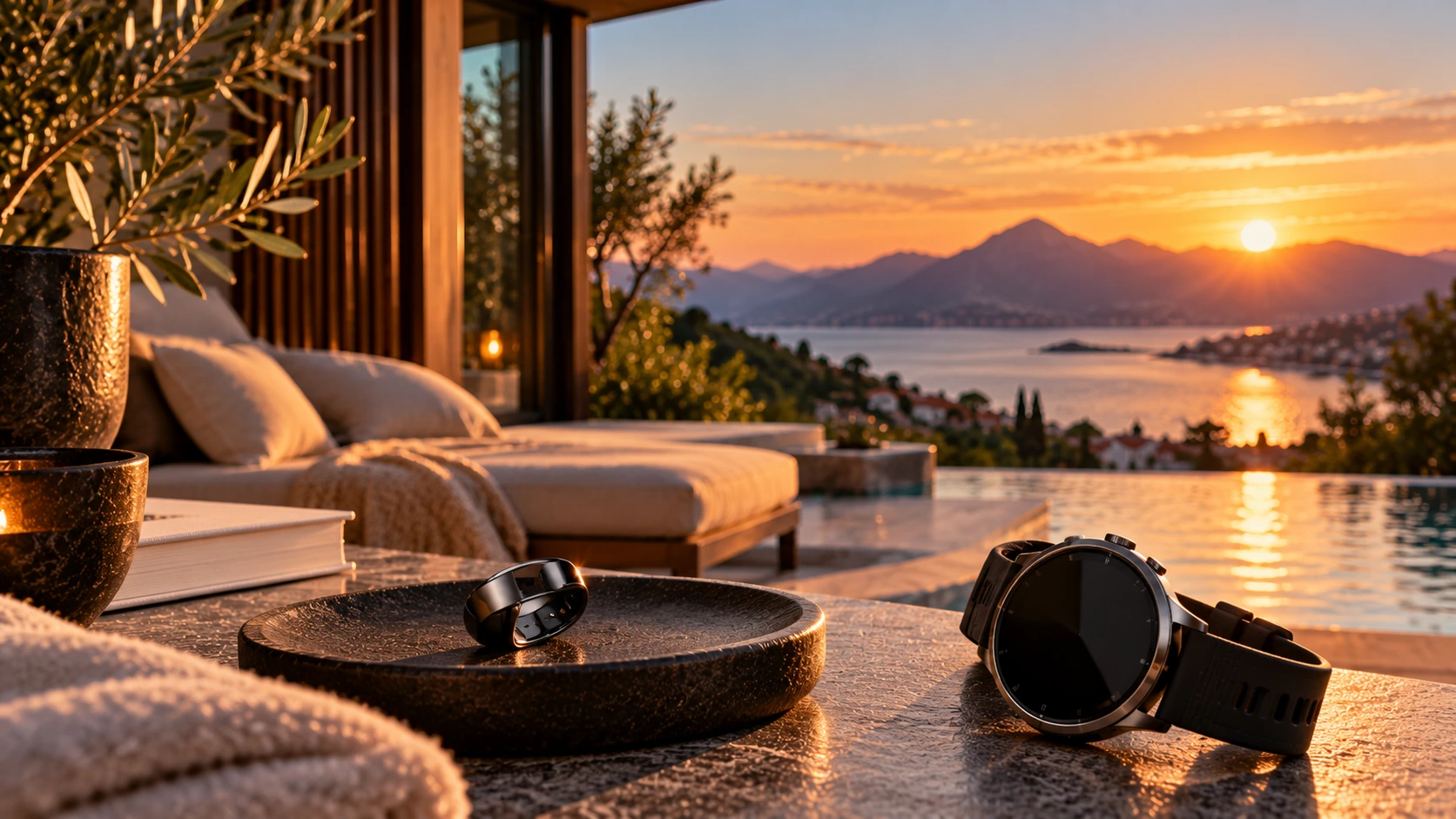
The best wearable is the one comfortable enough to collect consistent data without becoming another distraction.
Smart ring questions worth asking.
Is a smart ring better than a smartwatch for sleep?
A smart ring can be more comfortable and less intrusive overnight, which may make consistent sleep tracking easier. Smartwatches can also provide detailed sleep estimates, particularly when worn consistently overnight.
Can a smart ring replace a smartwatch?
It can if your priorities are passive health, sleep and recovery tracking. It is less likely to replace a watch if you rely on GPS, live workout metrics, notifications, calls, apps or navigation.
Are smart rings accurate?
Modern rings can provide useful physiological trends, but accuracy varies by metric, device and individual. Consumer wearables should not automatically be treated as substitutes for clinical equipment.
Are smart rings worth the money?
They can be worthwhile for someone who values continuous sleep and recovery trends and will use the information. Value also depends on purchase price, battery life and any ongoing subscription.
Can you wear a smart ring and smartwatch together?
Yes. For some users this is an excellent combination: the ring can handle unobtrusive overnight and recovery tracking while the watch provides GPS, workouts, notifications and a display during the day.
Which would we choose?
For pure sleep and recovery tracking, we like the logic of the smart ring.
Not because a ring magically understands your body better, but because its form encourages the behaviour that matters most: wearing it consistently.
For sport and broader everyday functionality, the smartwatch remains extremely difficult to beat.
And for someone deeply interested in both? The most capable answer may not be ring or watch. It may be using each for what it does best.
The point isn't to collect more data. It's to understand enough to make better decisions.