Smart Bed vs Bed Cooling System: Which Is Better for Sleep?
Sleep technology is moving far beyond mattresses. From temperature-controlled covers to intelligent beds that monitor recovery and adjust through the night, we look at what you are really paying for.
If you sleep too hot, wake frequently or obsess over recovery data, technology now promises to redesign the eight hours you spend in bed.
At one end are increasingly sophisticated smart beds and sleep systems capable of monitoring sleep, adjusting temperature and, depending on the system, changing firmness or position.
At the other are dedicated bed cooling systems designed to solve a much more specific problem: keeping your sleeping environment at a more comfortable temperature.
One offers an ecosystem. The other offers a targeted intervention.
Smart Bed vs Bed Cooling System at a Glance
| Factor | Smart Bed / Integrated System | Bed Cooling System |
|---|---|---|
| Main purpose | Broader sleep optimisation | Temperature management |
| Cooling | Available on some premium systems | Usually the core function |
| Heating | Often available on temperature-controlled systems | Available on some systems |
| Sleep tracking | Often integrated | Usually limited or absent |
| Automatic adjustment | Potentially sophisticated | Usually focused on temperature |
| Keep existing mattress | Depends on the product | Often yes |
| Complexity | Higher | Generally lower |
| Best for | People wanting a complete sleep-tech ecosystem | People primarily trying to sleep cooler or warmer |
Your Bedroom Can Feel Cool While Your Bed Doesn't.
Temperature is one of the more interesting areas of sleep optimisation because the body does not maintain exactly the same thermal state throughout the night.
Core body temperature normally follows a daily rhythm and falls around the transition into sleep. Your bedding, mattress, clothing and bedroom environment all influence how easily heat can dissipate.
This helps explain why simply turning down the thermostat does not solve every hot sleeper's problem. A mattress and duvet can create their own warm microclimate around the body.
Room Temperature
The temperature of the surrounding bedroom matters, but it is only one part of the sleep environment.
Bed Microclimate
Your body, mattress and bedding create a much more immediate thermal environment around you.
Two Sleepers
Couples can have completely different temperature preferences, making dual-zone control particularly interesting.
Changing Needs
The ideal temperature may not remain identical throughout the entire night.
What Is a Smart Bed?

The term smart bed has become broad enough to describe several different types of product.
Some systems focus on adjustable positioning. Others monitor movement, breathing or sleep patterns. More advanced sleep systems can combine temperature management, sleep tracking and automatic changes designed to respond to the sleeper throughout the night.
That makes the proposition very different from buying a premium mattress.
You are increasingly buying a piece of technology that happens to live in the bedroom.
The appeal of the smart bed
Its strongest argument is integration. Instead of using one device to track sleep, another to cool the bed and perhaps another adjustable base for comfort, the system attempts to bring multiple functions together.
For someone already interested in wearables, recovery scores and sleep optimisation, that can be enormously attractive.
But integration also introduces a question we think matters at Frequency High Life: how much technology do you really need in order to sleep well?
What Is a Bed Cooling System?
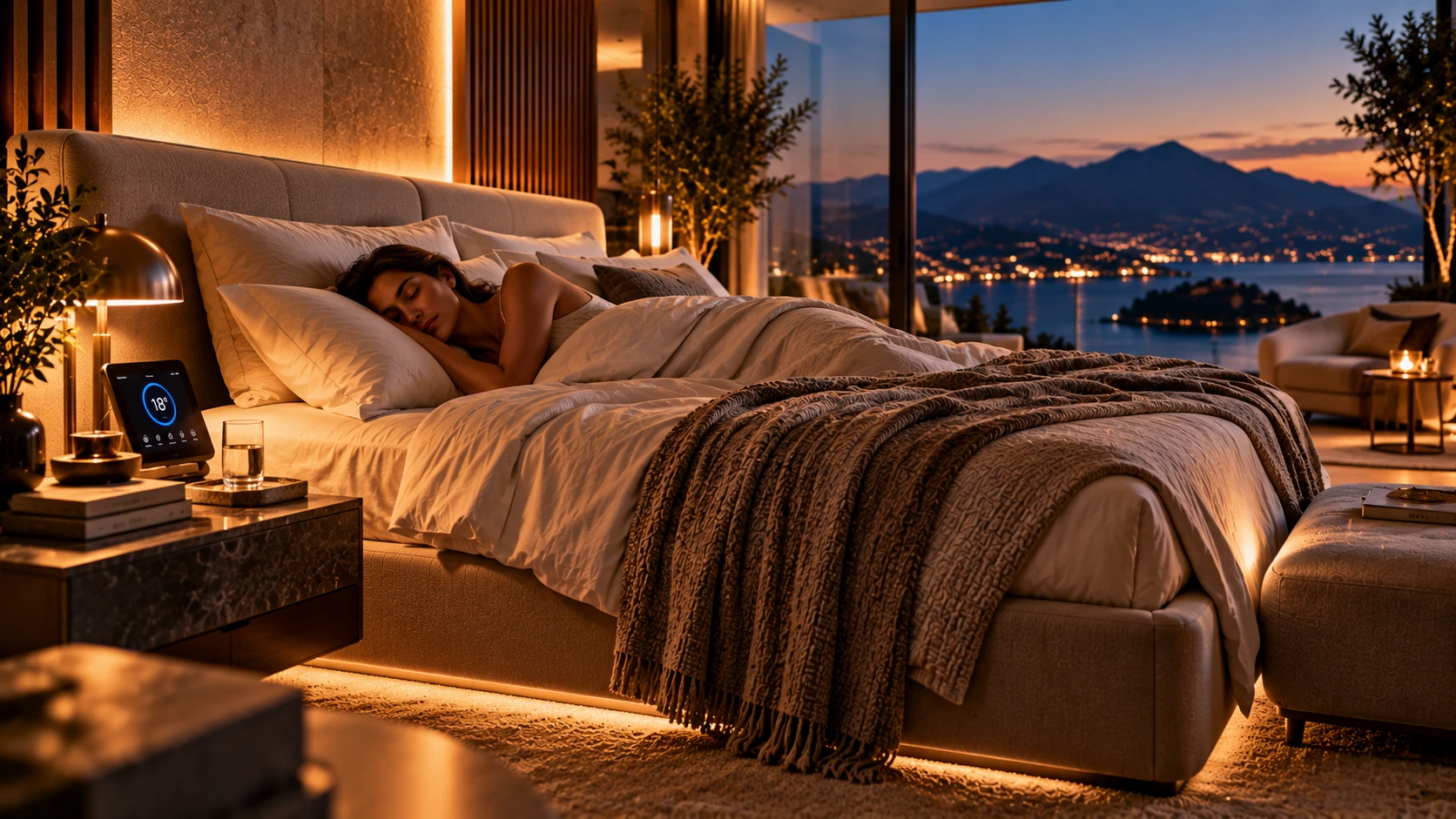
A bed cooling system takes a narrower approach.
Rather than trying to reinvent the whole bed, it is designed primarily to influence the temperature immediately around the sleeper.
Different technologies approach this in different ways. Some circulate temperature-controlled water through a mattress cover or pad. Others move conditioned air beneath the bedding.
The attraction is obvious: if you already own a mattress you love, you may be able to add active temperature control without replacing it.
This narrower purpose can also make the buying decision easier. You are not necessarily paying for another set of sleep scores or an ecosystem of metrics. You are paying for a cooler — or sometimes warmer — sleeping environment.
Can Cooling Your Bed Improve Sleep?
There is a reasonable physiological basis for taking temperature seriously. Thermoregulation and sleep are closely connected, and the body's thermal changes interact with the sleep-wake cycle.
But that does not mean every expensive cooling product automatically produces better sleep for every person.
Someone regularly waking because they feel uncomfortably hot has a very different problem from someone sleeping badly because of stress, alcohol, inconsistent bedtimes, noise or an underlying sleep disorder.
This is also why individual experience matters. If temperature is not a problem for you now, adding active cooling simply because the technology exists may be an expensive solution looking for a problem.
Do You Need Your Bed to Track You?
Sleep tracking is one of the biggest dividing lines between a simple cooling system and a more comprehensive smart sleep setup.
For some people, passive tracking is ideal. There is no watch to charge and no ring on the finger. The bed simply collects information while you sleep.
That can create useful trends around sleep duration, consistency, resting heart rate and other measurements, depending on the system.
But more data is not automatically more useful.
Sleep scores are estimates produced by algorithms. They can help reveal patterns, but they should not become a nightly examination result.
The FHL rule
Use sleep data to identify patterns and make better decisions. Don't let the score decide how you are supposed to feel when you wake up.
Dual-Zone Temperature May Be the Killer Feature.
One person wants the window open. The other wants another duvet.
For couples with very different temperature preferences, the ability to control each side of the bed independently may be more valuable than almost every other smart feature.
A dual-zone system can potentially allow one side to run cooler while the other remains warmer.
That is a meaningful example of technology solving a real-world problem rather than simply generating another dashboard.
Hot Sleeper
Active cooling can target the immediate bed environment without forcing the whole bedroom to become uncomfortably cold.
Cold Sleeper
Where independent heating is supported, the other side can remain warmer without adding layers across the entire bed.
What Should You Compare?
Premium sleep technology can become expensive very quickly. Before focusing on brands, compare what the systems actually do.
- Temperature range: how much meaningful heating and cooling control does the system provide?
- Dual-zone control: can two sleepers choose different settings?
- Automation: can temperature change automatically through the night?
- Sleep tracking: do you want integrated data or already get enough from a wearable?
- Mattress compatibility: can you keep the bed you already own?
- Noise: does the system introduce pumps, fans or other bedroom sound?
- Maintenance: does it require water, filters, cleaning or regular servicing?
- Subscription: are important features dependent on an ongoing membership?
- Partner comfort: does the setup work independently on each side?
- Total ownership cost: consider the initial purchase and the cost of running the system over several years.
Choose a Smart Bed If...
- You want sleep technology integrated into one broader system.
- You value passive sleep and recovery tracking.
- You like automation and personalised settings.
- You are already considering replacing or substantially upgrading your bed.
- You want temperature control plus additional intelligent features.
- You are comfortable paying more for a connected sleep ecosystem.
Choose a Bed Cooling System If...
- Your main problem is sleeping too hot.
- You already own a mattress you like.
- You want temperature control without replacing the whole bed.
- You already track recovery with a smart ring or smartwatch.
- You prefer a more focused solution with fewer unnecessary features.
- You and your partner have very different temperature preferences.
When Is Expensive Sleep Technology Worth It?
We are interested in premium products at Frequency High Life, but price alone is never the reason something belongs here.
Sleep is important enough that genuinely useful technology can justify serious investment. You use a bed every night. Small improvements, repeated over years, can matter far more than the occasional luxury purchase.
But that logic can also make sleep an easy category to over-market.
A four-figure system should solve something meaningful.
Smart Bed vs Bed Cooling FAQs
What is the difference between a smart bed and a bed cooling system?
A smart bed or integrated smart sleep system may combine features such as sleep tracking, temperature management, positioning and automatic adjustments. A dedicated bed cooling system primarily focuses on controlling the temperature around the sleeper.
Do you need a new mattress for a bed cooling system?
Not necessarily. Many temperature-control products are designed to work with an existing mattress, although compatibility depends on the individual system.
Can couples have different bed temperatures?
Some dual-zone systems allow each side of the bed to use different temperature settings, which can be particularly useful when partners have different sleep preferences.
Is a smart bed worth the money?
It can be if you will genuinely use its integrated features and they address specific sleep problems or preferences. If temperature is your only concern, a dedicated cooling solution may offer better value.
Is bed cooling better than air conditioning?
They solve related but different problems. Air conditioning changes the temperature of the room, while a bed cooling system targets the microclimate immediately around the sleeper. Some people may benefit from one, the other or a combination of both.
Can a smart ring replace smart bed sleep tracking?
For many people, a smart ring already provides substantial sleep and recovery information. Integrated bed tracking may therefore be less important unless you prefer passive tracking without wearing a device or want the data to interact with other bed functions.
Smart Bed or Bed Cooling System?
If your primary problem is temperature, we would start with temperature.
A dedicated bed cooling system has an appealing simplicity: keep the mattress you already enjoy and change the thermal environment around your body.
A smart bed becomes more interesting when you want something broader — temperature control, tracking, automation and a more integrated sleep environment.
Neither automatically guarantees better sleep.
And that is probably the most important point.
Good sleep does not become better simply because it produces more data. Premium sleep technology earns its place when it quietly solves a real problem night after night.
That is when paying more begins to make sense.